(Spring 2019) This project branched out of work completed with the City of Tulsa’s award-winning Urban Data Pioneers program and become a second senior capstone for my undergraduate degree, completed individually. For more details on Urban Data Pioneers, please visit their website.
According to Princeton University’s Eviction Lab, the City of Tulsa processed over 6,000 evictions in 2016, making it the city with the 11th highest eviction rate in the U.S. However, Tulsa currently has no publicly available record of these evictions and where or when they occur— a huge obstacle for mitigation and legal aid services trying to reach at-risk renters.
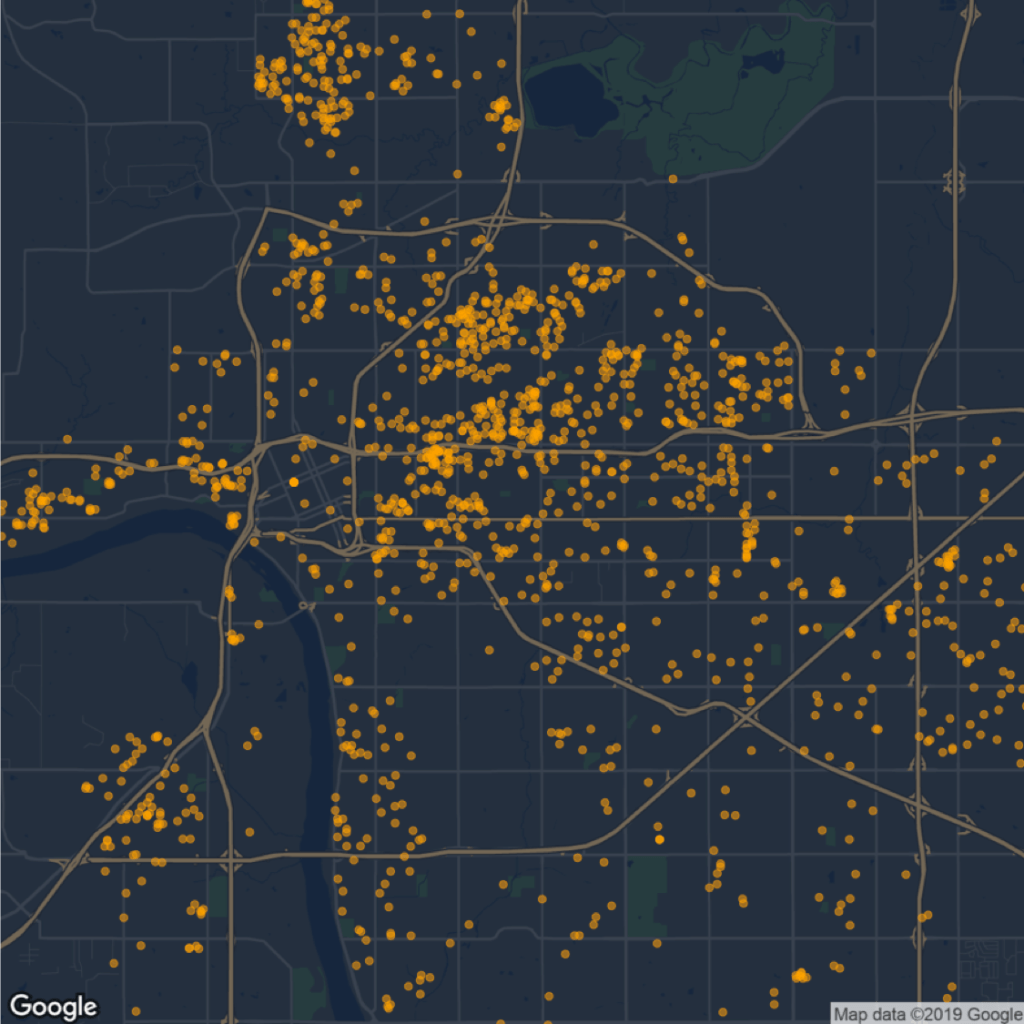
Using an extensive public dataset of water meter billing data, in combination with county court data scraped by the Oklahoma Policy Institute, I implemented a method for predicting where evictions among single-family housing units most likely occurred in Tulsa from 2009-2019. The results of this data analysis can be seen at right, where each dot corresponds to a parcel which was predicted to have been evicted at least once during the 10-year period.
Notably, the results closely correlate with Tulsa’s lowest-income and most marginalized neighborhoods. Other dimensions of this analysis confirmed that a relatively small percentage of landlords accounted for an overwhelming majority of eviction-related court proceedings. They also suggested a need for more affordable, multi-family housing options among Tulsa’s low-income communities, particularly around the Kendall-Whittier area and far North Tulsa.
For detailed anonymized results, code, and presentation materials please submit a personal request.
 aaron krusniak